Floating Aquarium Plants vs Rooted Marginal Plants: Paludarium Guide
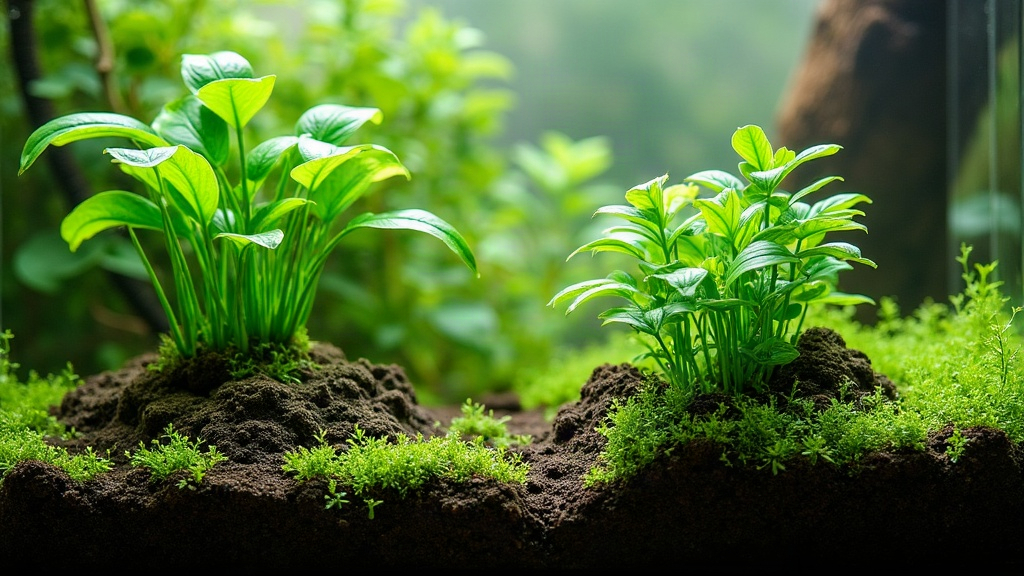
Floating vs. Rooted Marginal Plants in a Paludarium
Picking between floating plants and rooted marginals for your paludarium’s water section really boils down to one trade-off. Floaters give you fast coverage, shade, and nutrient uptake, and they ask almost nothing of you in return. Rooted marginals take longer and need substrate and proper lighting, but they build a far more stable, naturalistic little ecosystem. Here’s the thing though: most paludariums that actually thrive end up using both. Once you understand what each group does well, it’s much easier to figure out where each one belongs in your tank.
What Are Floating Aquarium Plants?
Floating plants sit on or just under the water’s surface, pulling nutrients straight out of the water column rather than soil. A few go-to choices for paludarium builds:
- Duckweed (Lemna minor) – tiny, multiplies fast, a favorite in frog and shrimp setups
- Water lettuce (Pistia stratiotes) – bigger rosettes, decent shade, roots that fry and shrimp love to hide in
- Frogbit (Limnobium laevigatum) – grows at a reasonable pace, nice trailing roots that look good trailing down
- Salvinia – a floating fern that’s surprisingly good at soaking up excess nitrates
Pros:
- You get visual payoff almost immediately, often within days instead of weeks
- No substrate required, which works great if you’re running a bare-bottom or stripped-down water section
- They choke out algae naturally by beating it to the light and nutrients
- Give fish, shrimp, or tadpoles somewhere to hide and feel safe
- Simple to thin out or remove entirely if things get out of hand
Cons:
- They can shade out submerged plants or the substrate underneath, sometimes badly
- Certain species (duckweed being the classic offender) spread like wildfire and are a pain to fully get rid of once established
- They don’t add much in the way of landscape architecture, they’re more functional than beautiful
- Waterfalls and strong flow, both common in paludariums, tend to push them straight into the filter intake
What Are Rooted Marginal Plants?
Marginals keep their roots submerged or sitting in wet substrate while their leaves poke up above the waterline, basically recreating that natural transition zone where water meets land. Some popular picks:
- Dwarf sagittaria and chain sword – stays low, works well in shallow areas
- Pothos (Epipremnum aureum) – roots handle constant wetness fine, and the vines will happily climb up the land section
- Peace lily (Spathiphyllum) – copes well with semi-aquatic roots and adds some height to the layout
- Acorus (sweet flag/grass) – grassy look, does best right at the water’s edge
- Anubias and Bucephalandra (rhizome-attached to hardscape) – not technically rooted in substrate, more anchored to wood or rock, so they sit somewhere between the two categories
Pros:
- They create a believable land-to-water gradient, which is basically the whole point of a naturalistic paludarium
- Help hold the substrate in place and cut down on cloudy water from disturbed debris
- Add vertical structure, climbing or tall marginals double nicely as background greenery
- Plenty of species handle both fully submerged and semi-emersed conditions, so you’ve got flexibility in how you design around them
- Their root systems, once established, actually pull a lot of nitrates out of the water thanks to the larger biomass
Cons:
- They take their time, usually 2 to 4 weeks before you see real growth
- Need a proper substrate layer (aqua soil, clay-based mix, or a planted false bottom), no shortcuts here
- Need light reaching all the way down to the waterline, and floating plants can easily block that
- More prone to transplant shock than floaters, so handle with care when moving them
Which Should You Choose?
Go with floating plants if:
- You want fast nutrient control and algae kept in check
- Your paludarium has shrimp, fry, or small amphibians that need surface cover to feel secure
- You’re running a bare-bottom or low-hardscape water section
Go with rooted marginals if:
- You’re after a naturalistic biotope with a real, visible water-to-land transition
- You’ve got at least 2 to 3 inches of decent substrate in place
- You want plants that anchor the whole design long-term, not just a quick fix
Combine both when:
- You need fast water quality control up front (floaters) while marginals slowly get their roots established
- Your layout has solid hardscape, driftwood or rock, where marginals can attach and floaters can fill in the gaps around them
- You’re dealing with bioload from fish or amphibians and want filtration happening on multiple levels at once
Practical Setup Tips
- Plant your marginals first, then add floaters sparingly (keep coverage under 30 to 40% of the surface) so light still gets down to submerged foliage.
- Net out duckweed or salvinia once a week. Overgrowth is hands down the most common complaint people have about floating plants.
- Feed your marginals with root tabs or a nutrient-rich substrate; floaters pull directly from the water column, so they’re not competing for substrate nutrients anyway.
- Keep an eye on water flow. Misting systems and waterfalls, both staples of paludarium design, will scatter floaters around, so it helps to set up a calmer backwater pocket just for them.
Final Thoughts
Floating plants and rooted marginals are really solving two different problems in your water section. Floaters are your quick, hands-off fix for water quality and cover. Marginals are what give the tank its structure and that naturalistic look that makes a paludarium actually look like a paludarium. For most builds, mixing the two, marginals doing the aesthetic heavy lifting, floaters keeping the water chemistry in line, is what gets you the healthiest tank and the best-looking result.